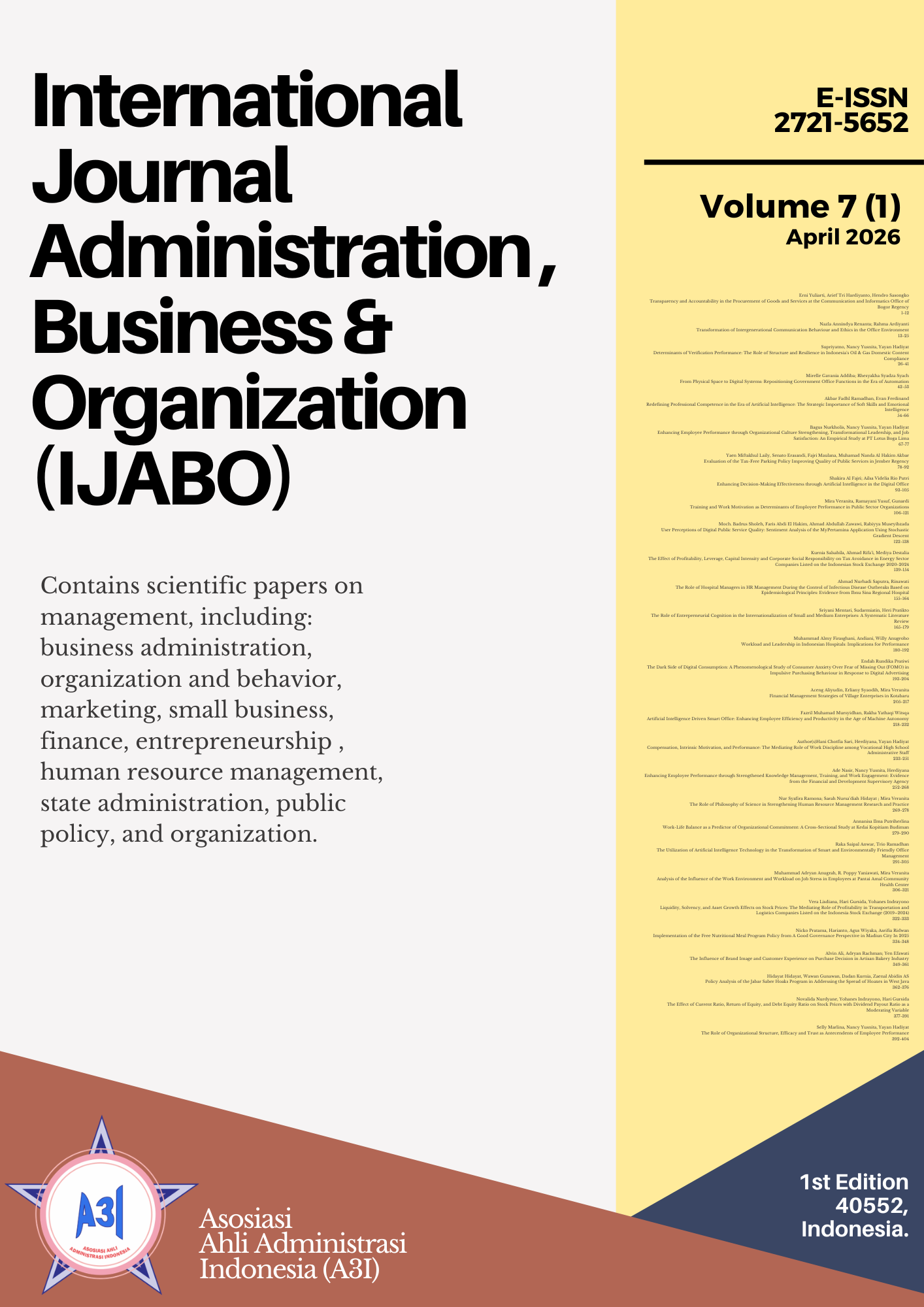
The Role of Organizational Structure, Efficacy and Trust as Antecendents of Employee Performance
Abstract
This study aims to analyze the influence of organizational structure and self-efficacy on employee performance with trust as an intervening variable in the Cianjur Regency Manpower and Transmigration Office. The phenomenon of fluctuating and suboptimal performance achievement encourages the importance of a comprehensive understanding of the interaction of structural, psychological, and relational factors in public organizations. The study used a quantitative approach with a total sampling of all active employees. Data were collected through a Likert scale questionnaire and analyzed using path analysis and Sobel test to test the effects of mediation. The results of the study show that organizational structure has a direct effect on performance but not on trust. Self-efficacy has a significant effect on confidence but does not have a direct effect on performance. Trust has proven to be the most dominant predictor and mediates the relationship between self-efficacy and performance. These findings confirm that optimizing employee performance requires an integrative approach that balances structural system improvement with strengthening trust-based social capital to improve the quality of public services.
References
Ahmad, Syahril, Muhdi, Djafar, Ibrahim, B. Hi, Mustajab, Duta, Irawan, Andri, & Aldrin, Mohamad. (2025). The Effect of Employee Motivation on Employee Performance with Work Involvement as a Mediation Variable. 3(3), 664–680.
Alwisol. (2019). Personality Psychology.
Atmaja, A. T. (2020). The Effect Of Basic Life Support (Bls) Training On The Preparedness Of The First Wave Of Muhammadiyah Disaster Management Center (Mdmc) Volunteers In Jember Regency. University of Muhammadiyah Jember.
Bangun, W. (2012). Human Resource Management.
Barus, Kharisma Yusuf, & Novandalina, Arini. (2025). Self-Efficacy and Involvement in Encouraging Employee Performance. 23(2), 221–240.
Chaniago, H., Hidayat, H., & Efawati, Y. (2025). Intrinsic Motivation and the Use of Artificial Intelligence (AI) in the Public Sector: Evidence from Indonesia. Revista Brasileira de Políticas Públicas, 15(2).
Chaniago, H., & Efawati, Y. (2026). Individual absorptive capacity as a stepping stone for digitalization, digital transformation, and small business performance; Entrepreneurial perspectives. Contaduría y administración, 71(2), 1-36. https://doi.org/10.22201/fca.24488410e.2026.5126
Chaniago, H., Muharam, H., & Efawati, Y. (2023). Metode Riset Bisnis dan Permodelan. Bandung: Edukasi Riset Digital, PT.
Colquitt, & Jason, A. (2019). Organizational Behavior. McGraw-Hill Education.
Donni June Priansa. (2016). Human Resources Planning & Development. CV. Alphabet.
Efendi, Yumita. (2025). The Effect of Knowledge Sharing, Organizational Commitment and Leadership on the Performance of Surabaya Health Office Employees, Disease Prevention and Control. 3(2019), 132–146. https://doi.org/10.29138/jkis.v3i2.59
Efawati, Y. (2023). Trust as Antecedent of Innovative Behavior in the Workplace. International Journal Administration, Business & Organization, 4(3), 35-47. https://doi.org/10.61242/ijabo.23.381
Efawati, Y. (2020). The influence of working conditions, workability and leadership on employee performance. International Journal Administration, Business & Organization, 1(3), 8-15. https://doi.org/10.61242/ijabo.20.40
Eze, S. C., Bello, A. O., & Adekola, A. T. (2017). The effects of organizational structure on the performance of organizations. European Journal of Business.
Hidayat, Rais, Patras, Yuyun Elizabeth, Harjanto, Sutji, & Suhardi, Eka. (2019). Analysis of Trust Variables in Organizations Using the Rasch Model. Journal of Management, 10(1), 19. https://doi.org/10.32832/jm-uika.v10i1.1894
Luthans, F., Luthans, B. C., & Luthans, K. W. (2021). Organizational Behavior: An Evidence-Based Approach Fourteenth Edition.
Mahipalan, M., Sheena, & Muhmmed, S. (2019). Examining the Role of Workplace Spirituality and Teacher Self-efficacy on Organizational Citizenship Behaviour of Secondary School Teachers: An Indian Scenario. VISION: The Journal of Business Perspective, 23(1), 80–90.
Nadia Anggara Putri. (2025). The Effect Of Self-Efficacy On Employee Performance Through Job Satisfaction As An Intervening Variable. 4(10), 7353–7368.
Nurain, A., Chaniago, H., & Efawati, Y. (2024). Digital Behavior and Impact on Employee Performance: Evidence from Indonesia. Journal of Technology Management & Innovation, 19(3), 15-27. http://dx.doi.org/10.4067/S0718-27242024000300015
P. Robbins, S. (2016). Organizational Structure (Keti Edition). Salemba Four.
Pratomo, Ridho. (2022). The Effect of Self-Efficacy on Employee Performance with Employee Attachment as an Intervening Variable. Journal of Applied Management and Finance, 11(04), 1021–1033. https://doi.org/10.22437/jmk.v11i04.16752
Putri, Z. Q. F., & Efawati, Y. (2025). Exploring the Impact of Customer Data Security on Consumer Trust in Gojek's Digital Services. International Journal Administration, Business & Organization, 6(1), 136-145.
Sugiyono. (2019). Educational Research Methods: Quantitative, Qualitative Combination, R and D. Alphabet.
Copyright (c) 2026 Selly Marlina, Nancy Yusnita, Yayan Hadiyat

This work is licensed under a Creative Commons Attribution-ShareAlike 4.0 International License.
Authors who publish in this journal agree to the following terms:
- The authors confirm that they are the authors of the submitted article, which will be published (online) in the journal IJABO (International Journal Administration, Business & Organization) by the Asosiasi Ahli Administrasi Indonesia (A3i), Bandung, Indonesia. The author’s name will be evident in the article. The publisher makes all decisions regarding the layout and distribution of the work.
- Authors guarantee that the work is their own original creation and does not infringe any statutory or common-law copyright or any proprietary right of any third party. In case of claims by third parties, authors commit themself to defend the interests of the publisher and shall cover any potential costs.
- Authors retain copyright and grant the journal the right of first publication, with the work simultaneously licensed under a Creative Commons Attribution-ShareAlike 4.0 International License (CC BY-SA 4.0). This license allows the redistribution and reuse of papers provided the authorship is properly credited.
- Authors can enter into separate, additional contractual arrangements for the non-exclusive distribution of the journal's published version of the work (e.g., posting it to an institutional repository or publishing it in a book), with an acknowledgment of its initial publication in this journal.
- Authors are permitted and encouraged to post their work online (e.g., in institutional repositories or on their website) prior to and during the submission process, as this can lead to productive exchanges and earlier and greater citations of published work.